
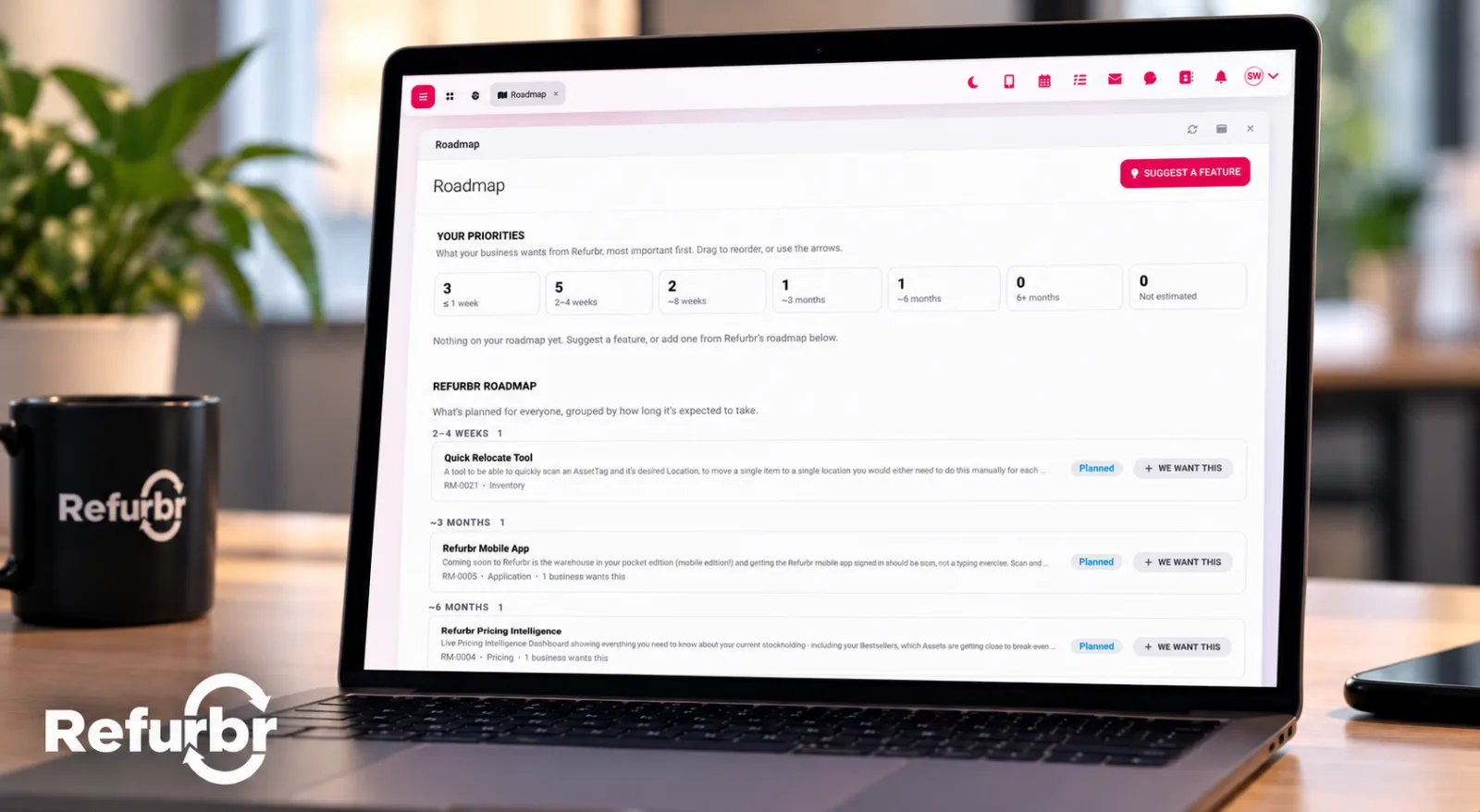
Every business running someone else's software has had this conversation.
You ask for something. Not an unreasonable something — a field that matters in your workflow, a report your finance team needs in a particular shape, an integration with the courier you've used for nine years. The answer comes back: good idea, we'll add it to the roadmap.
If you've been doing this a while, you've probably learned to hear that as a polite no.
It usually isn't. Most requests that go onto a roadmap do get built. What nobody can honestly tell you is when — and for some requirements, when is the entire question.
What "on the roadmap" actually means
A shared roadmap is sequenced by weight of demand. Every customer's request goes into the same list, and what gets built first is what the most businesses are asking for.
That is not a flaw. It is the reason a shared platform is good value: you benefit from every other customer's requests as much as your own, and the product improves far faster than any single business could fund by itself. Most of what we shipped in September — Goods In rebuilt, the new reconciliation and supplier claims process, the mobile app — started life as somebody's feature request, and every customer got all of it at no extra cost.
But sequencing by demand has a predictable consequence. The more specific a requirement is to how you operate, the fewer other businesses are asking for it, and the longer it waits.
So the thing you lose isn't the feature. It's the date.
And "sometime" is difficult to plan a business around. If a capability determines whether you can take on a contract, open a site, or commit to a customer's SLA, needing it eventually isn't the same as needing it in March.
Why vendors can't just promise a date
This isn't vendors being difficult. It's architecture.
Most software, including Refurbr's Basic tier, runs multi-tenant: everyone uses the same application on shared infrastructure. It's what keeps it affordable, well-tested and quick to improve, and for the large majority of businesses it's the right trade.
But every change lands for everybody. A field you want added is a field every other customer now sees. A workflow tweak that suits your process disrupts someone whose process is different. So changes have to be generalised, consulted on and built to work for everyone — which takes time, and pushes anything highly specific further down the order.
The result is a kind of gravity. The software gradually becomes an average of what all its customers need. For most businesses that's fine — if you run a conventional operation, the average is close enough to right, and you get the benefit of everyone else's thinking for free.
It stops being fine when your process is the thing that makes you competitive, or when a date is non-negotiable.
What Dedicated changes
Refurbr Dedicated runs your own instance on your own infrastructure. The servers are the mechanism, not the point.
The point is what separate infrastructure makes possible: your own roadmap, with development capacity allocated to it every month.
Not a request queue. Not a feature vote. A standing conversation about what your business needs next, and a team building it for your instance — where the only question is whether it's right for you, because nobody else is affected by it.
And because the capacity is yours rather than shared, you get the thing a shared roadmap can never offer: a date you can plan against.
Every month you decide what that capacity goes on. It might be:
- An integration with a marketplace, courier, diagnostics tool or accounting system we don't support as standard
- A workflow that matches how your bench actually runs, rather than how the platform assumes benches run
- A report in the exact shape your finance team or your auditor wants it
- A customer-facing portal that behaves the way your contracts require
- A change to how grading, pricing or allocation works, because your rules aren't everyone's rules
The question changes from "will enough other customers want this?" to "do you want this?"
Who actually needs it
Most Refurbr customers don't. Basic is the right answer for the majority, and we'll tell you so — putting a business on Dedicated that doesn't need it serves nobody.
The businesses that do tend to look like one of these:
Operations whose process is their advantage. You've spent years refining how stock moves through your building, and that refinement is why your margins work. Generic software asks you to work like everyone else, which quietly erodes the thing you built.
Businesses with a system we don't integrate with. An in-house WMS, a bespoke customer portal, a finance system from a vendor nobody else in refurbishment uses, a contractual data feed for a corporate client. These sit at the bottom of a shared roadmap indefinitely, because the number of other customers asking for them is zero.
Contract-driven operations — typically ITAD. When your customers impose SLAs, audit requirements and data handling obligations on you, you need to impose them on your software too. SLA guarantees and a named contact stop being nice-to-haves and start being things your own contracts depend on.
High-volume and multi-entity setups. Several warehouses, 3PL partners, multiple legal entities and currencies. Volume alone rarely justifies Dedicated — complexity does.
Businesses that want an exit from software risk entirely. Dedicated includes buyout options. If depending on a third party for the system that runs your operation is a risk your board won't carry indefinitely, there's a route out of it. Very few vendors in this space will have that conversation at all.
What else comes with it
The roadmap is the substance. The rest of the tier exists to support it:
Dedicated servers for your organisation — the thing that makes custom development possible without destabilising anyone else, and that gives you performance characteristics nobody else's workload can affect.
SLA guarantees, so uptime is a commitment rather than an expectation.
Premium support with a named contact — someone who knows your setup, rather than a queue where you explain it again each time.
Multi-warehouse and 3PL support for operations running across several sites and partners.
Everything in Basic, unchanged: IMEI and serial-level tracking, multi-channel order sync, marginal and reverse charge VAT, buyback workflows, picking and fulfilment, onboarding and training.
Dedicated starts from £1,450 a month, priced to the scope of what you need. Basic is £475 a month. Neither has per-user or per-location fees, and both include unlimited users and locations — scale has never been the thing we charge for.
The honest version
Most businesses reading this should stay on Basic, or start there. It's a complete platform, not a cut-down one, and the shared roadmap moves quickly.
If you're on Basic and there's something you want built, send it to us. Weight of demand is genuinely how the order gets decided, and a request nobody tells us about can't be weighed. Plenty of what shipped this year arrived that way.
Dedicated is for the narrower case: where the gap between how the software works and how your business works has become expensive, or where you need a date rather than a place in a queue.
If that sounds like you, it's worth a conversation. If it doesn't, we'll say so.
Book a demo → https://www.refurbr.co.uk/book-demo or email us on hello@refurbr.co.uk